

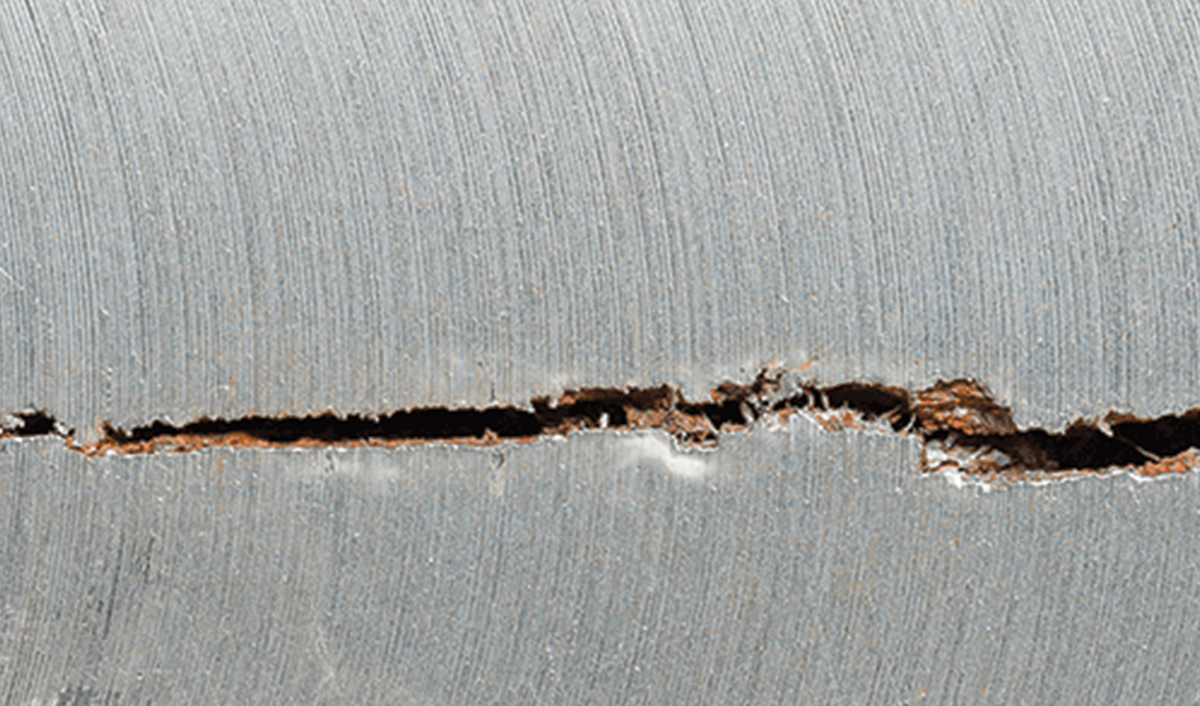
Hydrogen embrittlement can cause high-strength steel components to crack or fail unexpectedly after hydrogen enters the material. It can occur during electroplating, pickling, acid cleaning, welding, corrosion, and other processes.
Once hydrogen enters susceptible steel, it can interact with the material's microstructure and stress levels, increasing the risk of cracking and delayed failure.
Understanding how this happens and how to control the risk is important for reliable components.
Hydrogen embrittlement is a form of metal degradation that occurs when hydrogen enters a susceptible metal and reduces its ability to withstand stress without cracking.
The problem is particularly important for high-strength steels. Hydrogen can move through the material and collect around microstructural features, defects, and highly stressed areas. When hydrogen and tensile stress interact in susceptible steel, microscopic cracks can develop and grow.
A simple way to understand the risk is:
Susceptible material + hydrogen + stress = hydrogen embrittlement risk
Hydrogen exposure alone does not mean a component will automatically fail. Strength, hardness, microstructure, hydrogen concentration, residual stress, applied load, and manufacturing processes all affect susceptibility.
Read more: What is Induction Hardening? A Comprehensive Guide
Hydrogen can enter steel during manufacturing or service.
This makes process control important throughout a component's manufacturing and service life.
High-strength steel provides excellent load-bearing performance, but increasing strength and hardness can also increase susceptibility to hydrogen embrittlement.
Microstructure matters too. Heat treatment influences the steel's strength, hardness, toughness, and overall structure.
Residual and applied tensile stresses can further increase the risk. Threads, notches, holes, and sharp corners can concentrate stress and create vulnerable areas where cracking may begin.
However, high strength alone does not cause hydrogen embrittlement. The risk comes from the combination of material susceptibility, hydrogen, and stress.
Hydrogen embrittlement can be difficult to detect because a component may look normal before failure.
The general process is:
Hydrogen enters the steel → hydrogen moves through the material → hydrogen accumulates at vulnerable locations → stress acts on the material → cracks develop → failure can occur.
Hydrogen can interact with dislocations, grain boundaries, inclusions, and other microstructural features. Researchers have proposed several mechanisms to explain this behavior.
Another important characteristic is delayed fracture. A component may survive manufacturing and initial loading but fail later when hydrogen, stress, and material susceptibility combine.
Prevention requires controlling both the material and the manufacturing process.
| Prevention Method | Purpose |
| Material selection | Reduces susceptibility |
| Controlled heat treatment | Develops the required properties |
| Stress relief | Helps reduce residual stress |
| Process control | Limits hydrogen introduction |
| Coating control | Reduces hydrogen exposure |
| Hydrogen bake-out | Helps reduce diffusible hydrogen |
| Testing | Verifies process effectiveness |
Material selection should be considered early, followed by careful control of processes that can introduce hydrogen. For susceptible components, suitable heat treatment and post-process hydrogen relief may also be required.
Check out: What Does Steel Tempering Do?
Hydrogen bake-out is a controlled heat treatment used to reduce hydrogen embrittlement risk, particularly after processes such as electroplating.
Heating increases hydrogen mobility within the steel. Under suitable conditions, this can help hydrogen diffuse out of the component or move toward trapping sites where it becomes less mobile.
The treatment is not a universal recipe. Steel grade, hardness, strength, coating, geometry, hydrogen exposure, temperature, treatment time, and applicable specifications all need to be considered.
ASTM B1031 guides heat treatments used to reduce internal hydrogen embrittlement risk and emphasizes that baking should be properly tailored and validated. Baking should not automatically be considered a complete solution for every component.
Testing helps determine whether a material or manufacturing process presents a hydrogen embrittlement risk.
Methods can include sustained-load and incremental step-load testing. ASTM F519 is commonly used to mechanically evaluate hydrogen embrittlement associated with plating, coating processes, and service environments.
Testing can also help manufacturers qualify new coating or manufacturing processes and verify whether hydrogen relief treatments are effective.
Hydrogen embrittlement is particularly relevant to high-strength components used in demanding applications, including:
Risk varies depending on the material, manufacturing process, design, stress level, and operating environment.
You might like to know about Heat Treatment: Process, Temperatures & Benefits
The right heat treatment can help manage hydrogen-related failure risks.
Contact Axiom HT to discuss hydrogen bake-out and heat treatment solutions tailored to your material, component, process, and specifications.